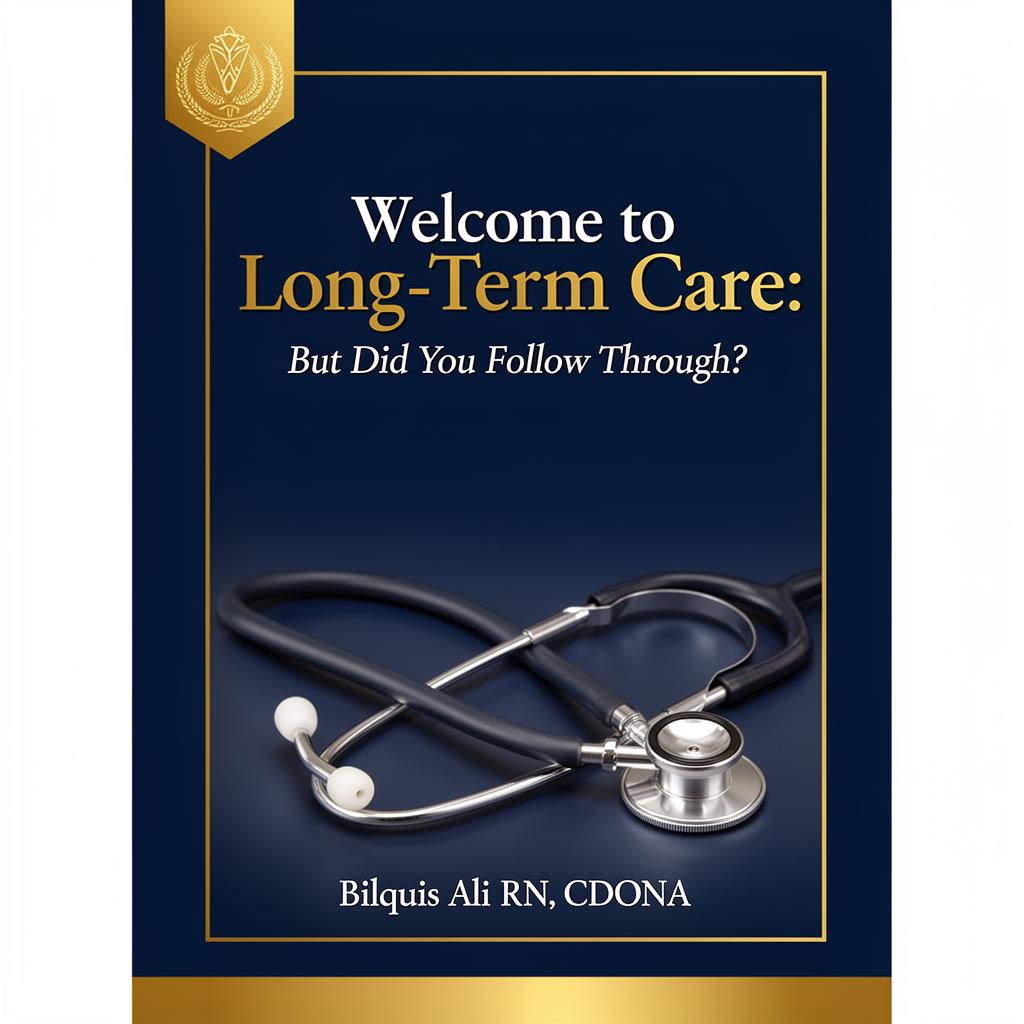
But Did You Follow Through?™
By Bilquis Ali, RN, CDONA
A no-nonsense guide written from the floor — for every role in long-term care. From CNAs to Directors of Nursing, this book meets you where you are and pushes you toward where you need to be.

This book is for every person who has ever walked into a long-term care facility and felt the weight of it.
CNA
Who is exhausted but still shows up
Charge Nurse
Who holds the shift together while everyone else falls apart
Unit Manager
Trying to keep a unit functioning with half a team
New DON
Who thought they were ready and is now questioning everything
ADON
Carrying the clinical load and the leadership weight
Seasoned DON
Who still wonders if they're doing enough — you are
MDS Coordinator
Navigating regulatory complexity every single day
Administrator
Who needs to understand what the clinical team actually faces
Bilquis Ali, RN, CDONA started as an LPN in a long-term care facility. She failed her boards — twice. She raised her children as a single mother. She cried in her car more times than she can count. And she became a six-figure Director of Nursing with an associate's degree.
This book is everything she learned along the way — not from textbooks, but from the floor. From the shifts. From the impossible staffing situations, the surveys, the staff who quit without notice, and the residents who deserved more than the system gave them.
Every chapter ends with the same question — and every role in the building is covered.
Real talk — before chapter one.
Bilquis shares her unfiltered journey: failing boards twice, single motherhood, and the moment she realized long-term care doesn't just make nurses — it builds clinicians. This is the invitation that frames every chapter.
You don't just become one. You're built into one.
From LPN to six-figure DON with an associate's degree — this chapter redefines what it means to lead. It's not about your title or the letters behind your name. It's about your skill, your systems, and your ability to lead people through chaos.
The real truth about being a Director of Nursing.
Staffing crises. Emotional weight. The regulatory maze. The gap between what nursing school taught you and what the building actually demands. This chapter says out loud what every DON thinks in silence — and shows you how to lead through it.
This is where everything changes.
The DON Thinking Framework: a 6-step root cause analysis system. From falls to wounds to behaviors — stop treating symptoms and start identifying causes. The intervention must match the root cause, or it's just documentation filler.
So you're not the one running around like crazy.
Morning Clinical. The Follow-Through System. Incident & Fall Review. Medication Pass Efficiency. Education & Competency. Your building should run with you — not because of you. Seven systems every DON must have in place.
Why your team makes or breaks you.
People don't leave buildings — they leave leaders. Retention is culture, built one decision at a time. Accountability conversations. Developing leaders, not just workers. The standard you accept is the standard you set.
Stay ready so you don't have to get ready.
Survey is not an event — it's your daily systems. What surveyors actually look for. Documentation that saves you or sinks you. Daily survey prep questions. If your systems are strong, survey will reflect it.
This is where everything either comes together — or falls apart.
The 5-step Follow-Through System: Assign it clearly, set a deadline, check it same day, validate — don't just accept, evaluate the outcome. Knowledge without execution is just intention. The DON that wins is the one who follows through.
A guide for every person in the building.
This book was written for every person in the building. Not just the nurses. Not just the leaders. Every person — because every person affects the quality of life of the people who live here. Each chapter follows a consistent structure with role-specific reflection questions.
How every role connects inside a long-term care building.
A visual reference showing how every role — from the Governing Body to CNAs, from Social Services to Maintenance — connects to the mission of resident care. Understanding the structure helps every person see where they fit.
The Clinical Authority After Hours.
The DON's delegate during evenings, nights, and weekends. Making high-stakes clinical decisions independently — hospital transfers, acute changes, staffing crises. Ensuring the building operates at the same standard at midnight as it does at noon.
The Anchor of Consistency.
The bridge between facility-wide leadership and bedside care. Continuity of care, quality monitoring, staff development, family communication, and care conferences. The quality of life on the unit traces directly back to this role.
The Clinical Guardian of Nutrition.
Nutrition is not just about food — it's a critical component of clinical care. Weight loss, wound healing, infection prevention, and F-tag compliance. Every clinical outcome is affected by what a resident eats.
Enriching Life Beyond Clinical Care.
Activities are therapeutic interventions, not entertainment. Individualized programming for every resident — including those on isolation, hospice, or with severe cognitive impairment. A resident who worked as a teacher for forty years is not served by a craft project designed for children.
The Emotional Infrastructure of the Building.
Psychosocial assessments, advance directives, resident rights advocacy, discharge planning, grief management, and family conflict. Moral courage is not optional — when a resident's voice is being ignored, the social worker must speak.
The Clinical Engine of the Shift.
Administering medications, assessing residents, managing a CNA team, communicating with physicians using SBAR, and documenting care — simultaneously. The most demanding and most underappreciated position in the building.
Building and Sustaining the Workforce.
Recruiting, onboarding, developing, and retaining the workforce. The first 90 days determine whether someone stays. Exit interviews, legal compliance, the retention imperative, and why HR is a front-line force — not a back-office function.
From the front desk to the Medical Director.
Administrator, Medical Director, HR, Admissions, MDS, Medical Records, Infection Preventionist, Staff Development, Restorative Nurse, Wound Care, Receptionist, Housekeeping, Laundry, Central Supply — plus a closing "Bringing It All Together" chapter that ties every department to the same standard of follow-through.
"Follow-through is not a personality trait. It is a system. And it starts with you."
— Bilquis Ali, RN, CDONA
"This book changed how I lead my building. Every chapter felt personal — like she was talking directly to me."
— RN Supervisor, Texas
RN Supervisor
"I wish I had this when I first became DON. Real, practical, and honest. No fluff, no theory — just truth."
— DON, Ohio
Director of Nursing
"Finally — a book written by someone who has actually worked the floor. Every CNA should read this."
— ADON, Florida
ADON
"The staffing chapter alone was worth it. She gets it because she's lived it."
— Unit Manager, Georgia
Unit Manager